Showing posts with label the. Show all posts
Showing posts with label the. Show all posts
Saturday, June 8, 2013
Audi wins 24 Hours of Le Mans for the 8th in Turn 9 Years
 Okay - how many of you thought that Audi wasnt going to have a clear shot of winning the race? Anybody? well, it certainly is no surprise to me that Audi with their R10 won the 24 overall in 8 of the past 9 years , despite the Peugeot 908 dominating the first part of the race. never in my life have I seen such an amazing team dominate such an amazing race in the fashion that they have - especially when Peugeot was really putting pressure on them during the entire 24 hours. This truly was a perfect race for Audi, and a classic race for the 275,000 spectators that were on hand to see it who definitely got their moneys worth. Peugeot vows to come back next year after finishing second..and so, the battle between the diesels continues on, for sure. Le Mans Results 1. Dindo Capello (Italy) / Tom Kristensen (Denmark) / Allan McNish (Scotland) Audi Sport North America (Audi R10) 381 laps 2. Marc Gene (Spain) / Nicolas Minassian (France) / Jacques Villeneuve (Canada) Team Peugeot Total (Peugeot 908) 381 laps 3. Franck Montagny (France) / Christian Klien (Austria) / Ricardo Zonta (Brazil) Peugeot Sport Total (Peugeot 908) 379 4. Alexandre Premat (France) / Lucas Luhr (Germany) / Mike Rockenfeller (Germany) Audi Sport Team Joest (Audi R10) 374

Sunday, June 2, 2013
Ducati Terra Mostro The Dirt Monster Ducati

The Ducati Scrambler Of The 60s was popular in the USA, its primary market but disappeared when the company stopped producing singles to concentrate on twins. Aside from the pantah based, Cagiva Elephant, there has not been a Ducati dirt bike since. Pierre Terblanche (yes he of 999 infamy) on his way to being shown the door designed the Ducati Scrambler 1100 that never saw the light of day. But you can buy a Ducati Monster based dirt bike, just not from the factory. Its called the Terra Mostro.
In the summer of 2006 Kent Harle and Blaine Dehmlow of Overland Motorcycles, started with a drawing on a Napkin 50/50 of a true dual-sport bike that would be purpose built for the rider that has to explore those Outlying places in order to feel at home in this world. The Napkin progressed into a full-fledged motorcycle in late 2008. Overland Motorcycles concept is pretty simple. Take a previous generation Monster 695, and add dirtbike suspension and wheels to create the

The 695 engine offers just the right amount of power and is Critically 20lbs lighter then the larger engines Desmodue although that has not stopped at least one customer creating an S2R Terra Mostro.

The XR650 front forks are 46mm Kayaba cartridge sourced units and just one of the Monsters disc brakes are retained. Out back a longer, extruded aluminum swingarm massively extends the wheelbase to 60.4 "(1537mm). A longer, fully adjustable Wilbers shock goes along with it and Takasago Excel alloy wheels 21 "and 18" rims complete the dirt transformation. In this form the bike has 210mm (8.3 ") wheel travel at both ends. The engine is remapped with a Power Commander to suit the Dave Miller Concepts silencer with spark arrestor.
You end up with a reportedly friendly dual sport bike on and off road and one that seemed to impress the veteran journalist Alan Cathcart bike when he tested it

The 695 engine offers just the right amount of power and is Critically 20lbs lighter then the larger engines Desmodue although that has not stopped at least one customer creating an S2R Terra Mostro.

The XR650 front forks are 46mm Kayaba cartridge sourced units and just one of the Monsters disc brakes are retained. Out back a longer, extruded aluminum swingarm massively extends the wheelbase to 60.4 "(1537mm). A longer, fully adjustable Wilbers shock goes along with it and Takasago Excel alloy wheels 21 "and 18" rims complete the dirt transformation. In this form the bike has 210mm (8.3 ") wheel travel at both ends. The engine is remapped with a Power Commander to suit the Dave Miller Concepts silencer with spark arrestor.
You end up with a reportedly friendly dual sport bike on and off road and one that seemed to impress the veteran journalist Alan Cathcart bike when he tested it
Wednesday, May 15, 2013
The New License Plate Mount Pegs Mirror and Shocks
 This is the project in its current state.
I installed the new license plate mount from Lowbrow. Its bare steel, but I clear-coated it with a 2-part urethane (see earlier post for a link). Bolting it on was easy, but the painful part was removing the stock license plate mount! I ended up having to remove the whole fender, so I could drill out these fing rivets attaching the original mount to the fender. The big bonus though, in addition to losing the stock mount, was losing those reflectors on the bottom edge of the fender.
 Painful as it was, I like the new mount and the fact that those damn reflectors are gone.
I also installed some new, short 10" shocks from Licks today (http://www.lickscycles.com/catalog/product_info.php?products_id=1838). Very easy to bolt right on. Be sure to torque those bolts properly and use loctite...you dont want those to rattle loose at any point in time. So far the ride is not any more painful that I can tell compared to the stock shocks. They definitely feel shorter when youre on the bike. But Im not too sure you can see much of a difference. Per Licks Cycles, they break in, and the eye-to-eye measurement after that is 10". Maybe thats true...
The pegs mounted up just fine to some HD mid-controls I got off eBay for cheap. I was impressed with the pegs because they are very well made, they seem to be actual cast brass, instead of brass plate.
The pegs mounted up just fine to some HD mid-controls I got off eBay for cheap. I was impressed with the pegs because they are very well made, they seem to be actual cast brass, instead of brass plate.
 If I may mention it again, notice the absence of reflectors beneath the rear fender.
I also got around to putting the new mirror from Licks on there finally (link in previous post). The right one didnt fit because of the cables and what not, so Im just rockin the left side.
 Small, but with a decent field of vision.
Sunday, May 12, 2013
The Piaggio MP3 Tourer Specs and Price

Piaggio MP3 Tourer Specifications
- ENGINE TYPE : Single-cylinder QUASAR, 4-stroke, 4-valve
- CYLINDER CAPACITY : 492 cc
- BORE x STROKE :71 mm / 61 mm
- MAX POWER AT SHAFT : 40 cv
- MAX TORQUE : 40 ft.lbs at 5,550 rpm
- Max speed : 143 km/h
- Fuel tank capacity : 12 liters
- Fuel Consumption : 24-25 km/l
- Distribution : Electronic injection system
- Cooling System : Liquid
- Lubrication : n/a
- Ignition : Electronic inductive discharge
- Gears : Twist n go automatic CVT
- Clutch : n/a
- Chassis : Double cradle trellis made of high strength steel tubes
- Front Suspension : Parallelogram supporting two steering tubes
- Rear Suspension : Oscillating engine fixed to frame with swingarm
- Front Brake : Stainless steel double disc, 240 mm
- Rear Brake : Stainless steel disc, 280 mm
- Front Tire : 120/70, 12"
- Rear Tire : 140/70, 14"
- Length : 2160 mm
- Width : 775 mm
- Wheelbase : 1550 mm
- Seat Height : 785 mm
- Dry Weight : 262 kg
- Type Approval : EPA and CARB
- Colors : Gray
The 2013 Kawasaki Ninja 1000 ABS

The name is 2013 Kawasaki Ninja 1000 ABS. This bike delivers a mix of power, handling, looks, technology and rideability. The design is based on that of the Ninja ZX-6R, but features original font and colouring. This bike also built with supersport-style full-fairing bodywork. It’s gives the Ninja 1000 ABS a distinct, head-turning look of its own. Besides that, this is one impressive motorcycle. A bike that is equally at home carving through a twisty backroad with the best of the sportbikes. The bike also built with sporty instrument panel features a large analogue tachometer and multi-function LCD screen. The functions include speedometer, tachometer, fuel gauge, odometer, clock, dual trip meters, and warning lamps.

The power comes from 1,043cc engine type four-stroke, liquid-cooled, DOHC, four valves per cylinder, inline-four, fuel system addapted DFI® with four 38mm Keihin throttle bodies and oval sub-throttles, ignition used TCBI with digital advance and six-speed of transmission. The engine featuring a long-stroke design for instantaneous power. The brilliant idea for this engine is more about flexible and easy-to-use oomph than simply peak horsepower numbers. To decrease engine weight and improve heat transfer, the cylinders have linerless, chrome composite plated aluminium bores. The four 38mm Keihin downdraft throttle bodies inject a perfect mix of fuel and air into each combustion chamber with help from an advanced ECU, oval sub-throttles and a cool air intake system that routes fresh air to the airbox via ducts at the front of the bike.

For chassis, the 2013 Ninja 1000 features an advanced aluminum frame similar in design to the Ninja ZX™-10R’s. Kawasaki engineers added beautifully swooping bodywork and a handful of brilliant features. A highly rigid aluminium frame with high mass centralisation balances sharp turning and firm handling. The frame contributes to handling, offering a firm, planted feeling, good stability and light, nimble turning.

For suspension is handled by 41 mm inverted cartridge fork with stepless compression, rebound damping and adjustable spring preload in frontside. In rear used horizontal monoshock with stepless rebound damping and adjustable spring preload. For braking used dual 300mm petal-type rotors with radial-mount four-piston calipers in front and single 250mm petal-type rotor with single-piston caliper in rear, The Ninja 1000 is also available with an optional anti-lock brake system (ABS) for additional rider confidence when riding in slippery situations.

For color choices there are metallic stardust white and candy lime green. 2013 Kawasaki Ninja 1000 ABS released in US MSRP Price: $12,099 USD.
Saturday, May 11, 2013
In The News New DUCATI 848 EVO


DUCATI have just launched a fresher version of the new motorcycle, 848, called the DUCATI 848 EVO. The new sportsbike has a 140 hp Testastretta engine with steering dampers and like the big brother, 1198, has new Brembo monobloc brakes. Simply put, expect more performance than the 848. The matt finish bike you see here is the 848 EVO Dark Stealth, looks smashing, doesn’t it? The bike has been put to order from 20th of July for £9,995 from the dark stealth version and £10,695 for the standard red machine. Well, this was one Ducati bike no one got a whiff of before its release.
The 848 was probably found as ‘mild’ as it has ‘only’ 134 hp. The Evo also sees an increase in the torque figures to 72.3lb-ft (98Nm). All the beauties of a traditional Ducati have been carry forwarded from the 848 like the trellis frame, the single-sided swingarm and dual exhaust pipes, 5 spoke wheels, etc. The 848 has exhausts fitted with a catalytic converter and two probes to cater to Euro 3 emission norms.
The 848 was probably found as ‘mild’ as it has ‘only’ 134 hp. The Evo also sees an increase in the torque figures to 72.3lb-ft (98Nm). All the beauties of a traditional Ducati have been carry forwarded from the 848 like the trellis frame, the single-sided swingarm and dual exhaust pipes, 5 spoke wheels, etc. The 848 has exhausts fitted with a catalytic converter and two probes to cater to Euro 3 emission norms.


The bike weighs 168 kgs. As mentioned, it has the famous fuel injected L-Twin cylinder, 4 valve per cylinder Desmodromic, liquid cooled engine displacing 849.4cc with bore and stroke of 94 x 61.2mm and compression ratio of 13.2:1. Transmission is through the traditional 6 speed gearbox and has chain final drive and wet multiplate with hydraulic control clutch. Read more about the EVO’s Technical Specifications here.
There was no blog, no forum, and no website that covered any scoop whatsoever. Talking about websites, Ducati have also removed the original 848 webpage which probably means it will no longer be in production. With a new 796 Monster, 848 Evo and the upcoming Cruiser, Ducati has really shaken up itself. Good for us Duc Fans.Check the official DUCATI 848 EVO website.
There was no blog, no forum, and no website that covered any scoop whatsoever. Talking about websites, Ducati have also removed the original 848 webpage which probably means it will no longer be in production. With a new 796 Monster, 848 Evo and the upcoming Cruiser, Ducati has really shaken up itself. Good for us Duc Fans.Check the official DUCATI 848 EVO website.


Thursday, May 9, 2013
The History of MV AGUSTA


The marquee MV AGUSTA is associated with high end and beautiful motorcycles. Well, for this, this aint no rags to riches story. The Agusta family tycoon was a very well to do business family who started out with Aeroplanes. Giovanni Agusta founded the company in 1907, but after his death in 1927, it was Domenico Agusta who branched out to motorcycles as they were facing crunch time and Italy had started finding its flavour in 2 wheelers.
The Early Years
The first motorcycle project was a 2 stroke 98cc 2 geared bike, but with the Second World War, things had to be scrapped. In 1945, after the war, the project was officially launched for the public and the first MV Agusta was born. It was initially to be called Vespa 98, but it was found that the name had already been registered (Piaggio launched Vespa in 1946), so it was referred to simply by the number “98”. Thus began the journey of what soon became known as the Ferrari of the two wheeled world.
The Early Years
The first motorcycle project was a 2 stroke 98cc 2 geared bike, but with the Second World War, things had to be scrapped. In 1945, after the war, the project was officially launched for the public and the first MV Agusta was born. It was initially to be called Vespa 98, but it was found that the name had already been registered (Piaggio launched Vespa in 1946), so it was referred to simply by the number “98”. Thus began the journey of what soon became known as the Ferrari of the two wheeled world.


From the early 1950’s to late 1970’s, MV Agusta had enormous success in racing and were ridden by some of the most famous racers winning 75 world championships, 270 Grand Prix wins and 3027 international race wins. (Source-Wiki)
The wins helped MV in their publicity campaign and sales increased which was also because MV responded to customer demands. They also bought many technologies from the racing circuit to the road bikes. By 1953, MV Agusta was producing 20,000 bikes and largely credit could be given to the amazing 125 Pullman. The mid 1950’s saw the introduction of the 175cc class. MV Agusta produced the 175 CSS for street use and also developed a 175cc production racer for racing. Then in 1957 a young Mike Hailwood raced the MV 175cc.
The wins helped MV in their publicity campaign and sales increased which was also because MV responded to customer demands. They also bought many technologies from the racing circuit to the road bikes. By 1953, MV Agusta was producing 20,000 bikes and largely credit could be given to the amazing 125 Pullman. The mid 1950’s saw the introduction of the 175cc class. MV Agusta produced the 175 CSS for street use and also developed a 175cc production racer for racing. Then in 1957 a young Mike Hailwood raced the MV 175cc.


By the 60s, small cc motorcycle were decreasing in demands, so MV started producing bigger bikes starting from 250cc to 350cc as well as a 600 cc four-cylinder later evolved into a 750 cc, the 750 Sport which was capable of speeds of 220 Km/h. Why? Because although the 600 four cylinder was considered the first maxi motorbike and the engine was derived from Mike Hailwood’s 500 GP, Count Agusta made the 600 differently (which was detuned) from what was being raced and fans expected a racing bike. The bike flopped and so in 1970 MV introduced the 750 Sport which was race orientated and thus became an instant success. In 1975, an updated 750 Sport was introduced, the 750S America.


The 1960’s 500cc World Championships were dominated by MV Agusta. In 1968, the great Giacomo Agostini won the 350cc World Championship title, followed by five consecutive years of 350cc World Championships for MV. Between 1958 and 1974 MV Agusta had 17 straight world championship wins in the 500cc class. In the smaller 125cc class MV Agusta earned 5 championships and 2 in the 250cc series.


The 60s overall saw the motorcycle market slow down with the evolution of the family car trend and to worsen the situation, the visionary Count Domenico Agusta passed away in 1971. Mr. Agostini stepped in and for a while things looked bright, but MV focussed on only 2 models, the 350cc & the 750cc. But by then, the Japanese invasion which has already shut down many legendary English marques also forced MV Agusta to shut shop and by 1980, MV Agusta closed down.


The Resurrection by Cagiva
After a decade of shutting down, CAVIGA purchased the MV Agusta name trademarks in 1991. The Castiglioni family were the owner of the CAGIVA brand and they had demonstrated their managerial skill by creating Cagiva out of the ashes of the glorious Aermacchi AMF. Not only that, they have resurrected Ducati only a few years back.
Cagiva had their worked cut out as MV Agusta, the brand has its own heritage and it has to stick to its roots. At that time the concept of in-line 4 cylinders were quite alien to Europe, so Claudio Castiglioni thought of buying a Japanese engine but finally left that idea and created a totally new one. And in 1997 it introduced the first new MV Agusta motorcycle, the F4 Serie Oro, 750cc and followed it with limited editions such as the SPR (Special Production Racing).
After a decade of shutting down, CAVIGA purchased the MV Agusta name trademarks in 1991. The Castiglioni family were the owner of the CAGIVA brand and they had demonstrated their managerial skill by creating Cagiva out of the ashes of the glorious Aermacchi AMF. Not only that, they have resurrected Ducati only a few years back.
Cagiva had their worked cut out as MV Agusta, the brand has its own heritage and it has to stick to its roots. At that time the concept of in-line 4 cylinders were quite alien to Europe, so Claudio Castiglioni thought of buying a Japanese engine but finally left that idea and created a totally new one. And in 1997 it introduced the first new MV Agusta motorcycle, the F4 Serie Oro, 750cc and followed it with limited editions such as the SPR (Special Production Racing).


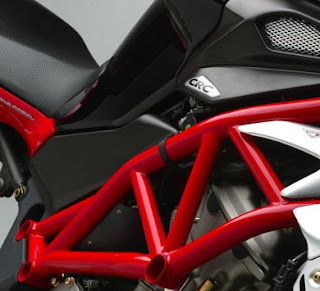
The F4 series was the motorcycle that launched the brand’s resurrection in 1998 and in 2004 they introduced their first 1000 cc F4 bike. The F4 series was created by famous motorcycle designer Massimo Tamburini, no introductions required at CRC (Cagiva Research Center). The built by hand F4 is unique with its four pipe undertail exhaust, single-sided swingarm and traditional MV Agusta red and silver livery. You would be probably surprised to know that during the design process Ferrari engineers assisted in the development of the engine because the basic engine was derived from the 1990-1992 Ferrari Formula One engine referred to as F4, but later deviated from the design keeping one important feature, the radial valves.


This liquid cooled, inline 4 stroke, four cylinder, DOHC, 16 radial valves, electronic multipoint injection one of the only production superbikes to have a cassette style transmission and radial valved engine.
Tamburini had years of experience working with BIMOTA (Bianchi, Morri and Tamburini). The first prototype was displayed on September 16 1997 on the eve of the 1997 salon in Milan. Critics hailed it instantly as the best sportbike in the world. The MV Agusta F4 is hailed as a benchmark in terms of innovation. From its style, looks, technical gadgets, performance, handling, there is no equal, except maybe the DUCATI series which is also incidentally credited to Mr. Tamburini. I have never ever ridden or even sat on a MV, but renowned critics have hailed the bike as the best handling motorcycles ever created. The bike was impressive for its speed of over 280 km/h and its extraordinary cycling component, universally considered to set the new standard.
Tamburini had years of experience working with BIMOTA (Bianchi, Morri and Tamburini). The first prototype was displayed on September 16 1997 on the eve of the 1997 salon in Milan. Critics hailed it instantly as the best sportbike in the world. The MV Agusta F4 is hailed as a benchmark in terms of innovation. From its style, looks, technical gadgets, performance, handling, there is no equal, except maybe the DUCATI series which is also incidentally credited to Mr. Tamburini. I have never ever ridden or even sat on a MV, but renowned critics have hailed the bike as the best handling motorcycles ever created. The bike was impressive for its speed of over 280 km/h and its extraordinary cycling component, universally considered to set the new standard.

Production of the new MV Agusta required a complete reorganisation of the productive cycle, converting the Schiranna plant for production of engines only, while final assembly was transferred to the new productive plant in Cassinetta di Biandronno. Then came the blisteringly beautiful BRUTALE, which gave a whole new meaning to the term ‘Naked motorcycle’. Standard models include the Brutale 750S, Brutale 910S, Brutale 910R and new for 2008 Brutale 1078RR. In 2005, MV Agusta introduced the Tamburini 1000, which is named after its creator, Massimo Tamburini. You must be well aware of the Ayrton Senna edition which came out in both the F4 750 cc and F4 1000 cc versions. Only 300 models of each were made.
Anyway, back to the history, for market reasons, in 1999 the Cagiva group was restructured and MV Agusta become the main brand comprising Cagiva and Husqvarna.
Anyway, back to the history, for market reasons, in 1999 the Cagiva group was restructured and MV Agusta become the main brand comprising Cagiva and Husqvarna.


The Coming Future
But making these high end motorcycles again took a toll on MV Agusta and by the end of 2004, the brand was bought by Malaysian carmaker Proton. However after exactly a year, MV Agusta got its roots back to Italy, thanks to GEVI SpA, a Genoa based financing company who bought back MV. To expand MV further and under financial constraint, in mid 2007, MV Agusta Motor S.p.A, sold the Husqvarna brand to BMW. And now as we know last year in July, Harley Davidson had announced that they are purchasing the MV Agusta brand for $109 Million and by August, it happened.
As relates to MV Agusta joining the SBK World Championship, well in May 2007, the company confirmed its return to racing in the 2008edition, but Carl Fogarty (who was heading the racing team) opted out due to lack of sponsorship and as such it still is status quo in 2009. No official dates as when they might join the SBK WC.
As relates to MV Agusta joining the SBK World Championship, well in May 2007, the company confirmed its return to racing in the 2008edition, but Carl Fogarty (who was heading the racing team) opted out due to lack of sponsorship and as such it still is status quo in 2009. No official dates as when they might join the SBK WC.


The index page of the official website with greet you with the following lines. "Moulding matter with the force of passion. By means of this philosophy, MV AGUSTA creates its models following a commitment that starts from expert craftsmanship and materializes into the rational language of standardization. For these reasons, the MV AGUSTA F4 and Brutale behold a different and unreachable beauty where the richness of contents reveal both the complexity of a product carefully handmade and the rational execution necessary for mass production. The consequent expressive value that results is close to a work of art that finds its contemporary presence in the technology adopted and in its destination."
There is no doubt the passion that the brand carries and it is very very evident in the products line up. Truly, this is pure art. Motorcyling, technical gizmos and everything else just falls into it.
There is no doubt the passion that the brand carries and it is very very evident in the products line up. Truly, this is pure art. Motorcyling, technical gizmos and everything else just falls into it.
Visit the official MV AGUSTA website for its stunning display of models and more inormation on the bikes.
Source: MV Agusta & Wiki
Wednesday, May 8, 2013
Slash 5 Changing the look of BMW


P.S - Some of the information here stand corrected as picked out by Mr. Greg Shamieh, a BMW enthusiast. I have made the changes in bold while keeping the previous lines in brackets. The corrections are also posted here.
Bayerische Motoren Werke arguably makes the world’s best motorcycle or even cars for that matter. Rock solid engineering is their forte. And this character has been built and got into the reputation over years of doing an excellent job at the factory. And although all of the BMW bikes are exemplary and well received all over the world, does it mean there is no definite stand out bike for BMW? You know like the XR 1200 and HD or the RD series and Yamaha or the Z series and Kawasaki. It could be because all of BMW bikes were/ are practical to its purpose or maybe all of them all so well received that it is difficult to associate a single symbolic bike with BMW. But, nonetheless, we can associate BMW with such a priceless gem that took the world by storm. Of course, it is the R ‘Slash’ series, BMW R50/2, R60/5, R75/6, etc. Let us not talk about the R32 as it is in a different plane altogether since it introduced the legendary boxer twin engine. Nonetheless there is a lot of history associated with the R series ‘Slash-5’.
It was this ‘Slash-5’ series that was introduced in 1970. With this BMW entered the age of modern motorcycles. To understand that or if your question is ‘how come?’ well, here is the answer. Since 1923 when the R32 came out with the boxer twin, it basically formed a unit for most future BMW motorcycles continuing till day. There were so many things on the R32, like single engine and gear box unit, shaft drive and the engine featured a recirculating wet-sump oiling system instead of total-loss oiling. That was way advanced in the 1920s, so advanced that they used the same feature till 1969.
It was this ‘Slash-5’ series that was introduced in 1970. With this BMW entered the age of modern motorcycles. To understand that or if your question is ‘how come?’ well, here is the answer. Since 1923 when the R32 came out with the boxer twin, it basically formed a unit for most future BMW motorcycles continuing till day. There were so many things on the R32, like single engine and gear box unit, shaft drive and the engine featured a recirculating wet-sump oiling system instead of total-loss oiling. That was way advanced in the 1920s, so advanced that they used the same feature till 1969.


In 1970, BMW introduced three new engines, a 500 cc, the R50/5, a 600 cc, the R60/5 and a top of the line 750 cc, the R75/5. What is the Slash-5 thing? Well, actually it looks different when you spell it out, you would remember the /2 bikes, the R50/2 and the R60/2 which came out till 1969, likewise this is the /5 series. These engines were new and advanced forms worked on the previous machines. The R75/5 was one of the fastest production motorcycles of the time reaching speeds of 110 mph (177 km/h). By the 60s and with the Japanese invasion, people were looking out for performance bikes. The Japanese sports bike became so popular that eventually all British and Italian bikes had to close store or just got sidelined. BMW was a company who would not just lie down, after all it has German blood you know. So the /5 series was a reply to the growing demands of the new emerging marquee. The new /5 series were built in BMW’s new facility in Spandau and before that till the /2 series, production was in the original factory in Munich. What the /5 series gained over the /2 series were telescopic forks losing out the Earles forks, electric starters to kick starters (retaining the kick starters as well), 12 volt electrical system replaced the 6 volt electrical systems while antiquated brakes and post WW II frames (remember the sidecars?) were replaced with new frames and brakes. There was judicious use of plastics and other non metal items and all these significantly reduced the weight of the bike.


The bikes had traditional BMW value, robustly build and performed just like a BMW should, exceptionally well. There were vast improvements over the /2 models. (No more shaft drives and no more bone crunching kick starts.) Actually shaft drive continued to be a BMW requirement up until the rotax engine singles in the F650 series. BMW tried to address it all. The /5 models are air-cooled, four-stroke, boxer twin engines with hemispherical combustion chambers. In the /2 series, the gear-driven camshaft was placed above the crank while for the/5 series, a duplex chain drives the camshaft that is located below the crankshaft. The engine is built around a one-piece tunnel crank-case. This arrangement assists lubrication of the camshaft. The valves are actuated by the camshaft through hardened followers, push rods and rocker arms. The Slash-5 series was a completely new design with a bottom to top new construction including newer suspension and a new flat-twin power unit. While all the 3 models were more or less of the same built and outfit save the difference in cubic capacity, the only notable difference was the carbs. The smaller 500cc and 600cc were equipped with slide-type carburetors with 26 mm throats while the R75/5 came with 32 mm constant vacuum carburetors. The clutch in all 3 models, however, were single-disk dry clutch. The engines looked similar in all 3 and it was just that the engines were bored out to increase the capacities. But this is a world made up of so many different people. You just can’t satisfy all with the same model. While the models did find favour in U.S, U.S being traditionally inclined to touring vehicles wanted their BMW a bit longer for more stability. So in 1972, {BMW obliged to the U.S people giving them a longer wheelbase and (without even asking) gave them a bigger fuel tank for the touring spirit. This elongated tank} became famously known as ‘toaster tank’ of course due to its resemblance to a toaster. The lengthening of the wheelbase was because with worn tires the bikes demonstrated some marked instability that was killing off potential customers.And the toaster tank is actually marginally shorter and much smaller fuel capacity – 5 gal compared to 6.5 for the regular’ kneepad’ tank. Since the rear swingarm was increased to result in a longer wheel base, these models were also known as ‘LWB’ models. Of course it did hamper its sporty nature of the original /5 series, but improved handling due to stability. Also the longer structure ensured that a larger battery could take the place of the former battery. The /2 series were losing the market to the fabulous four Japs, but the /5 series ensured that BMW slowly but surely were crawling their way back. Around 100,000 /5 series were sold in about 4 years and historically for BMW, they celebrated their 500,000th BMW motorcycle production in the form of a /5 series motorcycle.


The era of /5 series was very short for only 4 years from 1970 to 1973 but it was like a big steeping stone for BMW. In 1974, BMW introduced the Slash-5 model’s successor. Out came the Slash-” models which were far better off than the /5 models mainly in terms of nitty gritty things like front disc brakes, better instrumentation and a huge step was adding a fifth gear in the transmission. But the thing is that the /5 series was the benchmark on which these improvements were made. As such the /5 series is the first modern motorcycle from BMW. It was for 4 years only, but that 4 years transition period was probably the most important phase for BMW. This was the period when BMW generally associated with making rock solid tourer bikes (in a way, read slow bikes) changed its face to a bike builder that can give any other their money’s worth in terms of performance and would still have some left. Any BMW owner would say that s/he rides the world’s best motorcycle. And you can hardly argue with that. The bikes post /5, that is /6 onwards are absolute gem to ride and although even the pre 70s bike are equally great, riding them is tough at times for their stiff suspension and handling which by no way is taking away any credit as we need to realize from which time period it came from. As such the /5 series is special as this model was the bridge for BMW by which it crossed from being one of the great bike builders to being the best motorcycle builders.
Specifications:
Engine – Air cooled, 4 stroke, boxer twin 498cc/ 599cc/ 749cc engines
Bore x Stroke – 67 mm (500cc) 73.5 mm (600cc) 82 mm (750cc) x 70.6 mm (in all 3)
Power – 32 hp@6,800 rpm/ 40 hp@6,600 rpm/ 50 hp@6,400 rpm
Torque – 39 Nm@5,000 rpm/ 49 Nm @ 5,000 rpm/ 58 Nm@5,000 rpm
Top Speed – 140 kmph (87 mph)/ 159 kmph (99 mph)/ 175 kmph (109 mph)
Curb Weight – 452 lb (205 kg)/ 463 lb (210 kg)/ 463 lb (210 kg)
Alternator – Bosch 12 V/ 180 Watts
Spark Plugs – Bosch W230T30 / Champion N7Y
Fuel Tank – 18 (in Europe) / 24 (in U.S) liters
Tires Front and Rear – 3.25 x 19 and 4.00 x 18
Rims Front and Rear – 1.85 x 19 and 1.85 x 18
Specifications:
Engine – Air cooled, 4 stroke, boxer twin 498cc/ 599cc/ 749cc engines
Bore x Stroke – 67 mm (500cc) 73.5 mm (600cc) 82 mm (750cc) x 70.6 mm (in all 3)
Power – 32 hp@6,800 rpm/ 40 hp@6,600 rpm/ 50 hp@6,400 rpm
Torque – 39 Nm@5,000 rpm/ 49 Nm @ 5,000 rpm/ 58 Nm@5,000 rpm
Top Speed – 140 kmph (87 mph)/ 159 kmph (99 mph)/ 175 kmph (109 mph)
Curb Weight – 452 lb (205 kg)/ 463 lb (210 kg)/ 463 lb (210 kg)
Alternator – Bosch 12 V/ 180 Watts
Spark Plugs – Bosch W230T30 / Champion N7Y
Fuel Tank – 18 (in Europe) / 24 (in U.S) liters
Tires Front and Rear – 3.25 x 19 and 4.00 x 18
Rims Front and Rear – 1.85 x 19 and 1.85 x 18
Source of photos: BM Bikes UK and Wiki


Subscribe to:
Posts (Atom)