Showing posts with label of. Show all posts
Showing posts with label of. Show all posts
Saturday, June 8, 2013
Audi wins 24 Hours of Le Mans for the 8th in Turn 9 Years
 Okay - how many of you thought that Audi wasnt going to have a clear shot of winning the race? Anybody? well, it certainly is no surprise to me that Audi with their R10 won the 24 overall in 8 of the past 9 years , despite the Peugeot 908 dominating the first part of the race. never in my life have I seen such an amazing team dominate such an amazing race in the fashion that they have - especially when Peugeot was really putting pressure on them during the entire 24 hours. This truly was a perfect race for Audi, and a classic race for the 275,000 spectators that were on hand to see it who definitely got their moneys worth. Peugeot vows to come back next year after finishing second..and so, the battle between the diesels continues on, for sure. Le Mans Results 1. Dindo Capello (Italy) / Tom Kristensen (Denmark) / Allan McNish (Scotland) Audi Sport North America (Audi R10) 381 laps 2. Marc Gene (Spain) / Nicolas Minassian (France) / Jacques Villeneuve (Canada) Team Peugeot Total (Peugeot 908) 381 laps 3. Franck Montagny (France) / Christian Klien (Austria) / Ricardo Zonta (Brazil) Peugeot Sport Total (Peugeot 908) 379 4. Alexandre Premat (France) / Lucas Luhr (Germany) / Mike Rockenfeller (Germany) Audi Sport Team Joest (Audi R10) 374

Sunday, May 12, 2013
Harley Davidson of Penang Nite Event photos
Yea StreetER6 visited the Harley Davidson Nite of Penang ! Now we deliver you the hottest part of the event. Oven Fresh!


 Stay tuned, more photos on the way !
 |
| The Ducati Truck |
 |
| Panigale 1199 |
 |
| Diavel AMG |
 |
| Ninja 650r custom sticker |
 |
| Brothers |
 |
| ER6N 2012 Custom seat |
 |
| Z1000 Petronas livery |
 |
| The Duke 200 crew |
 |
| Superman is here too |
 |
| The Red Power |
 |
| The Doctor #46 |
Thursday, May 9, 2013
The History of MV AGUSTA


The marquee MV AGUSTA is associated with high end and beautiful motorcycles. Well, for this, this aint no rags to riches story. The Agusta family tycoon was a very well to do business family who started out with Aeroplanes. Giovanni Agusta founded the company in 1907, but after his death in 1927, it was Domenico Agusta who branched out to motorcycles as they were facing crunch time and Italy had started finding its flavour in 2 wheelers.
The Early Years
The first motorcycle project was a 2 stroke 98cc 2 geared bike, but with the Second World War, things had to be scrapped. In 1945, after the war, the project was officially launched for the public and the first MV Agusta was born. It was initially to be called Vespa 98, but it was found that the name had already been registered (Piaggio launched Vespa in 1946), so it was referred to simply by the number “98”. Thus began the journey of what soon became known as the Ferrari of the two wheeled world.
The Early Years
The first motorcycle project was a 2 stroke 98cc 2 geared bike, but with the Second World War, things had to be scrapped. In 1945, after the war, the project was officially launched for the public and the first MV Agusta was born. It was initially to be called Vespa 98, but it was found that the name had already been registered (Piaggio launched Vespa in 1946), so it was referred to simply by the number “98”. Thus began the journey of what soon became known as the Ferrari of the two wheeled world.


From the early 1950’s to late 1970’s, MV Agusta had enormous success in racing and were ridden by some of the most famous racers winning 75 world championships, 270 Grand Prix wins and 3027 international race wins. (Source-Wiki)
The wins helped MV in their publicity campaign and sales increased which was also because MV responded to customer demands. They also bought many technologies from the racing circuit to the road bikes. By 1953, MV Agusta was producing 20,000 bikes and largely credit could be given to the amazing 125 Pullman. The mid 1950’s saw the introduction of the 175cc class. MV Agusta produced the 175 CSS for street use and also developed a 175cc production racer for racing. Then in 1957 a young Mike Hailwood raced the MV 175cc.
The wins helped MV in their publicity campaign and sales increased which was also because MV responded to customer demands. They also bought many technologies from the racing circuit to the road bikes. By 1953, MV Agusta was producing 20,000 bikes and largely credit could be given to the amazing 125 Pullman. The mid 1950’s saw the introduction of the 175cc class. MV Agusta produced the 175 CSS for street use and also developed a 175cc production racer for racing. Then in 1957 a young Mike Hailwood raced the MV 175cc.


By the 60s, small cc motorcycle were decreasing in demands, so MV started producing bigger bikes starting from 250cc to 350cc as well as a 600 cc four-cylinder later evolved into a 750 cc, the 750 Sport which was capable of speeds of 220 Km/h. Why? Because although the 600 four cylinder was considered the first maxi motorbike and the engine was derived from Mike Hailwood’s 500 GP, Count Agusta made the 600 differently (which was detuned) from what was being raced and fans expected a racing bike. The bike flopped and so in 1970 MV introduced the 750 Sport which was race orientated and thus became an instant success. In 1975, an updated 750 Sport was introduced, the 750S America.


The 1960’s 500cc World Championships were dominated by MV Agusta. In 1968, the great Giacomo Agostini won the 350cc World Championship title, followed by five consecutive years of 350cc World Championships for MV. Between 1958 and 1974 MV Agusta had 17 straight world championship wins in the 500cc class. In the smaller 125cc class MV Agusta earned 5 championships and 2 in the 250cc series.


The 60s overall saw the motorcycle market slow down with the evolution of the family car trend and to worsen the situation, the visionary Count Domenico Agusta passed away in 1971. Mr. Agostini stepped in and for a while things looked bright, but MV focussed on only 2 models, the 350cc & the 750cc. But by then, the Japanese invasion which has already shut down many legendary English marques also forced MV Agusta to shut shop and by 1980, MV Agusta closed down.


The Resurrection by Cagiva
After a decade of shutting down, CAVIGA purchased the MV Agusta name trademarks in 1991. The Castiglioni family were the owner of the CAGIVA brand and they had demonstrated their managerial skill by creating Cagiva out of the ashes of the glorious Aermacchi AMF. Not only that, they have resurrected Ducati only a few years back.
Cagiva had their worked cut out as MV Agusta, the brand has its own heritage and it has to stick to its roots. At that time the concept of in-line 4 cylinders were quite alien to Europe, so Claudio Castiglioni thought of buying a Japanese engine but finally left that idea and created a totally new one. And in 1997 it introduced the first new MV Agusta motorcycle, the F4 Serie Oro, 750cc and followed it with limited editions such as the SPR (Special Production Racing).
After a decade of shutting down, CAVIGA purchased the MV Agusta name trademarks in 1991. The Castiglioni family were the owner of the CAGIVA brand and they had demonstrated their managerial skill by creating Cagiva out of the ashes of the glorious Aermacchi AMF. Not only that, they have resurrected Ducati only a few years back.
Cagiva had their worked cut out as MV Agusta, the brand has its own heritage and it has to stick to its roots. At that time the concept of in-line 4 cylinders were quite alien to Europe, so Claudio Castiglioni thought of buying a Japanese engine but finally left that idea and created a totally new one. And in 1997 it introduced the first new MV Agusta motorcycle, the F4 Serie Oro, 750cc and followed it with limited editions such as the SPR (Special Production Racing).


The F4 series was the motorcycle that launched the brand’s resurrection in 1998 and in 2004 they introduced their first 1000 cc F4 bike. The F4 series was created by famous motorcycle designer Massimo Tamburini, no introductions required at CRC (Cagiva Research Center). The built by hand F4 is unique with its four pipe undertail exhaust, single-sided swingarm and traditional MV Agusta red and silver livery. You would be probably surprised to know that during the design process Ferrari engineers assisted in the development of the engine because the basic engine was derived from the 1990-1992 Ferrari Formula One engine referred to as F4, but later deviated from the design keeping one important feature, the radial valves.


This liquid cooled, inline 4 stroke, four cylinder, DOHC, 16 radial valves, electronic multipoint injection one of the only production superbikes to have a cassette style transmission and radial valved engine.
Tamburini had years of experience working with BIMOTA (Bianchi, Morri and Tamburini). The first prototype was displayed on September 16 1997 on the eve of the 1997 salon in Milan. Critics hailed it instantly as the best sportbike in the world. The MV Agusta F4 is hailed as a benchmark in terms of innovation. From its style, looks, technical gadgets, performance, handling, there is no equal, except maybe the DUCATI series which is also incidentally credited to Mr. Tamburini. I have never ever ridden or even sat on a MV, but renowned critics have hailed the bike as the best handling motorcycles ever created. The bike was impressive for its speed of over 280 km/h and its extraordinary cycling component, universally considered to set the new standard.
Tamburini had years of experience working with BIMOTA (Bianchi, Morri and Tamburini). The first prototype was displayed on September 16 1997 on the eve of the 1997 salon in Milan. Critics hailed it instantly as the best sportbike in the world. The MV Agusta F4 is hailed as a benchmark in terms of innovation. From its style, looks, technical gadgets, performance, handling, there is no equal, except maybe the DUCATI series which is also incidentally credited to Mr. Tamburini. I have never ever ridden or even sat on a MV, but renowned critics have hailed the bike as the best handling motorcycles ever created. The bike was impressive for its speed of over 280 km/h and its extraordinary cycling component, universally considered to set the new standard.
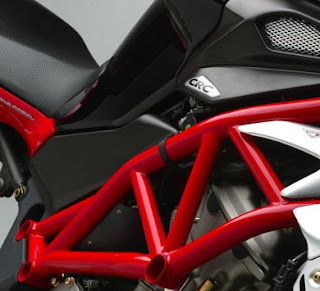

Production of the new MV Agusta required a complete reorganisation of the productive cycle, converting the Schiranna plant for production of engines only, while final assembly was transferred to the new productive plant in Cassinetta di Biandronno. Then came the blisteringly beautiful BRUTALE, which gave a whole new meaning to the term ‘Naked motorcycle’. Standard models include the Brutale 750S, Brutale 910S, Brutale 910R and new for 2008 Brutale 1078RR. In 2005, MV Agusta introduced the Tamburini 1000, which is named after its creator, Massimo Tamburini. You must be well aware of the Ayrton Senna edition which came out in both the F4 750 cc and F4 1000 cc versions. Only 300 models of each were made.
Anyway, back to the history, for market reasons, in 1999 the Cagiva group was restructured and MV Agusta become the main brand comprising Cagiva and Husqvarna.
Anyway, back to the history, for market reasons, in 1999 the Cagiva group was restructured and MV Agusta become the main brand comprising Cagiva and Husqvarna.


The Coming Future
But making these high end motorcycles again took a toll on MV Agusta and by the end of 2004, the brand was bought by Malaysian carmaker Proton. However after exactly a year, MV Agusta got its roots back to Italy, thanks to GEVI SpA, a Genoa based financing company who bought back MV. To expand MV further and under financial constraint, in mid 2007, MV Agusta Motor S.p.A, sold the Husqvarna brand to BMW. And now as we know last year in July, Harley Davidson had announced that they are purchasing the MV Agusta brand for $109 Million and by August, it happened.
As relates to MV Agusta joining the SBK World Championship, well in May 2007, the company confirmed its return to racing in the 2008edition, but Carl Fogarty (who was heading the racing team) opted out due to lack of sponsorship and as such it still is status quo in 2009. No official dates as when they might join the SBK WC.
As relates to MV Agusta joining the SBK World Championship, well in May 2007, the company confirmed its return to racing in the 2008edition, but Carl Fogarty (who was heading the racing team) opted out due to lack of sponsorship and as such it still is status quo in 2009. No official dates as when they might join the SBK WC.


The index page of the official website with greet you with the following lines. "Moulding matter with the force of passion. By means of this philosophy, MV AGUSTA creates its models following a commitment that starts from expert craftsmanship and materializes into the rational language of standardization. For these reasons, the MV AGUSTA F4 and Brutale behold a different and unreachable beauty where the richness of contents reveal both the complexity of a product carefully handmade and the rational execution necessary for mass production. The consequent expressive value that results is close to a work of art that finds its contemporary presence in the technology adopted and in its destination."
There is no doubt the passion that the brand carries and it is very very evident in the products line up. Truly, this is pure art. Motorcyling, technical gizmos and everything else just falls into it.
There is no doubt the passion that the brand carries and it is very very evident in the products line up. Truly, this is pure art. Motorcyling, technical gizmos and everything else just falls into it.
Visit the official MV AGUSTA website for its stunning display of models and more inormation on the bikes.
Source: MV Agusta & Wiki
TYPES OF MOTORCYCLES
There are many systems for classifying types of motorcycles. Six main categories are widely recognized: cruiser, sport, touring, standard, dual-purpose, and dirt bike.There is no universal system for classifying all types of motorcycles. There are strict classification systems enforced by competitive motorcycle sport sanctioning bodies, or by certain legal jurisdictions for motorcycle registration, emissions, road traffic safety rules or motorcyclist licensing. There are also informal classifications or nicknames used by manufacturers, riders, and the motorcycling media.


Standards are versatile, general purpose street motorcycles. They are recognized primarily by their upright riding position, partway between the reclining posture of the cruisers and the forward leaning sport bikes. Foot pegs are below the rider and handlebars are high enough to not force the rider to reach far forward, placing the shoulders above the hips in a natural position. Standards are often recommended to beginning motorcyclists due to their flexibility, relatively low cost, and moderate engines.


Scooter engine sizes range smaller than motorcycles, 50–650 cc, and have all-enclosing bodywork that makes them cleaner and quieter than motorcycles, as well as having more built-in storage space. Automatic clutches and continuously variable transmissions (CVT) make them easier to learn and to ride. Scooters usually have smaller wheels than motorcycles. Scooters usually have the engine as part of the swingarm, so that their engines travel up and down with the suspension.
CRUISER BIKES:


Cruisers are styled after American machines from the 1930s to the early 1960s, such as those made by Harley-Davidson, Indian, and Excelsior-Henderson. Harley-Davidsons largely define the cruiser category, and large-displacement V-twin engines are the norm, although other engine configurations and small to medium displacements also exist. Their engines are tuned for low-end torque, making them less demanding to ride because it is not necessary to shift as frequently to accelerate or maintain control.
The riding position places the feet forward and the hands are up relatively high, so that the spine is erect or leaning back slightly. At low to moderate speeds, cruisers are more comfortable than other styles,but riding for long periods at freeway speeds can lead to fatigue from pulling back on the handlebars to resist the force of the wind against the riders chest.Cruisers have limited cornering ability due to a lack of ground clearance.
Choppers are a type of cruiser. They are often custom projects that result in a bike modified to suit the owners ideals, and, as such, are a source of pride and accomplishment. Cruisers are sometimes called custom even in the absence of aftermarket modifications. Power cruiser is a name used to distinguish bikes in the cruiser class that have significantly more engine output, around 80–100 hp (60–75 kW) as opposed to about 50–70 hp (37–52 kW). They often come with upgraded brakes and suspensions, better ground clearance, and premium surface finishes, as well as more exotic or non-traditional styling.
SPORTS BIKES:


Sport bikes emphasize speed, acceleration, braking, and cornering on paved roads, typically at the expense of comfort and fuel economy in comparison to less specialized motorcycles. Because of this, there are certain design elements that most motorcycles of this type will share. Sport bikes have comparatively high performance engines resting inside a lightweight frame. Inline-four engines dominate the sport bike category, with V-twins having a significant presence, and nearly every other engine configuration appearing in small numbers at one time or another. The combination of these elements helps maintain structural integrity and chassis rigidity. Braking systems combine higher performance brake pads and multi-piston calipers that clamp onto oversized vented rotors. Suspension systems are advanced in terms of adjustments and materials for increased stability and durability. Most sport bikes have fairings, often completely enclosing the engine, and windscreens that effectively deflect the air at very high speeds, or at least reduce overall drag.
Sport bikes have high foot pegs that position the legs closer to the body to improve ground clearance when cornering, and a long reach to the hand controls, which positions the body and center of gravity forward, above the fuel tank. The rider leans forward into the wind, the force of which can comfortably support the riders weight at speeds near 100 mph (160 km/h), but at lower speeds leaves too much weight on the arms and wrists, causing fatigue.
Streetfighters are derived from sport bikes, originally being customized sport bikes with the fairings removed and higher handlebars replacing the low clip-on handlebars. Since the 1990s, factory streetfighters have been produced. As with naked bike and muscle bike, the name streetfighter is used to help clarify the middle ground occupied by designs that blend elements of both sport bikes and standards.
TOURING BIKES:


Although any motorcycle can be equipped and used for touring, touring motorcycles are specifically designed to excel at covering long distances. They have large-displacement engines, fairings and screens that offer good weather and wind protection, large-capacity fuel tanks for long ranges between fill-ups, and a relaxed, upright seating position. Passenger accommodation is excellent and expansive luggage space is the norm for this class. Large touring bikes are sometimes called dressers, especially those that are based on a cruiser platform. Such bikes can have wet weights of 850–900 lb (390–410 kg) and top 1,300–1,400 lb (590–640 kg) fully loaded with a rider, passenger, and gear.
STANDARD BIKES:


Standards are versatile, general purpose street motorcycles. They are recognized primarily by their upright riding position, partway between the reclining posture of the cruisers and the forward leaning sport bikes. Foot pegs are below the rider and handlebars are high enough to not force the rider to reach far forward, placing the shoulders above the hips in a natural position. Standards are often recommended to beginning motorcyclists due to their flexibility, relatively low cost, and moderate engines.
Standards usually do not come with fairings or windscreens, or if they have them, they are relatively small. Standard is often a synonym for naked bike, a term that became popular in the 1990s in response to the proliferation of fully faired sport bikes. The standard seemed to have disappeared, fueling nostalgia for the return of the Universal Japanese motorcycle (UJM), which were admired for their simplicity, quality, and versatility.Muscle bike is a nickname for a motorcycle type, derived from either a standard or sport bike design, that puts a disproportionately high priority on engine power.
DUAL-SPORTS BIKES:


Dual-sports, sometimes called dual-purpose or on/off-road motorcycles, are street legal machines that are also designed to enter off-road situations. Typically based on a dirt bike chassis, they have added lights, mirrors, signals, and instruments that allow them to be licensed for public roads. They are higher than other street bikes, with a high center of gravity and tall seat height, allowing good suspension travel for rough ground.
Adventure motorcycles are motorcycles with touring capability on paved and unpaved roads. As a dual sport they have a significant on pavement bias and perform well on pavement at higher speeds unlike most dual sports. Their size, weight and sometimes their tires however limits their off road capability. Most adventure motorcycles function well on graded dirt and gravel roads but are less than ideal on more difficult off pavement terrain.
Supermoto motorcycles were designed to compete on a single course that alternated between three genres of racing: road racing, track racing, and motocross. This increasingly popular type of motorcycle is often a dual-sport that has been fitted by the manufacturer with smaller rims and road tires. Supermotos are quickly gaining popularity as street bikes due to their combination of light weight, durability, relatively low cost, and sporty handling.
SMALL BIKES:


Scooter engine sizes range smaller than motorcycles, 50–650 cc, and have all-enclosing bodywork that makes them cleaner and quieter than motorcycles, as well as having more built-in storage space. Automatic clutches and continuously variable transmissions (CVT) make them easier to learn and to ride. Scooters usually have smaller wheels than motorcycles. Scooters usually have the engine as part of the swingarm, so that their engines travel up and down with the suspension.
Underbones are small-displacement motorcycle with a step-through frame, descendants of the original Honda Super Cub. They are differentiated from scooters by their larger wheels and their use of footpegs instead of a floorboard. They often feature a gear shifter with an automatic clutch.
The moped used to be a hybrid of the bicycle and the motorcycle, equipped with a small engine (usually a small two-stroke engine up to 50 cc, but occasionally an electric motor) and a bicycle drivetrain, and motive power can be supplied by the engine, the rider, or both.
In many places, mopeds are subject to less stringent licensing than bikes with larger engines and are popular as very cheap motorbikes, with the pedals seeing next to no use. Mopeds were very popular in the United States during the fuel-crisis of the late 1970s and early 1980s, but their popularity has fallen off sharply since the mid 1980s. In response to rising fuel prices in the first decade of the 2000s, U.S. scooter and moped ridership saw a resurgence. Sales of motorcycles and scooters declined 43.2% in 2009, and continued to decrease in the first quarter of 2010, with scooter sales doing worst, down 13.3% compared to a 4.6% drop for all two-wheelers. Other types of small motorcycles include the monkey bike, welbike, and minibike.
Subscribe to:
Posts (Atom)